

Display Fingerprint Lock App: Everything You Need to Know

Your phone stores your personal photos, messages, banking apps, passwords, and other sensitive information. Keeping this data secure is more important than ever, and a Display Fingerprint Lock App makes it easy to add an extra layer of protection.
Unlike your phone’s default screen lock, a display fingerprint lock app allows you to protect individual applications with fingerprint authentication. Whether you want to secure your banking app, social media accounts, or private gallery, these apps help keep your personal information safe from unauthorized access.
In this guide, you’ll learn what a Display Fingerprint Lock App is, how it works, how to set it up, its best features, common issues, and whether it’s worth using on your Android device.
What Is a Display Fingerprint Lock App?
A Display Fingerprint Lock App is an Android security application that lets you lock selected apps using your phone’s built-in fingerprint sensor. Instead of protecting only your entire device, it secures individual apps for additional privacy.
For example, you can lock:
- Banking and finance apps
- WhatsApp and messaging apps
- Photo and video galleries
- Email applications
- Social media apps
- Notes and document storage apps
Even if someone unlocks your phone, they still cannot access these protected apps without verifying your registered fingerprint.
Most Display Fingerprint Lock Apps are available on the Google Play Store and are designed for Android users who want stronger privacy without making their devices difficult to use.
How to Set Up a Display Fingerprint Lock App
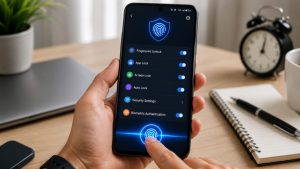
Setting up a Display Fingerprint Lock App is simple and only takes a few minutes. Follow these steps to secure your important apps with fingerprint authentication.
Step 1: Download a Trusted App
Open the Google Play Store and search for a reliable fingerprint app lock. Before installing, check the developer, user ratings, reviews, and download count to ensure the app is trustworthy.
Step 2: Grant Required Permissions
After installation, open the app and allow the permissions it needs to function correctly. Depending on your Android version, you may need to enable Accessibility or Device Administrator permissions.
If you also want to protect your private photos and videos, check out our Smart Photo App Lock guide to learn how to secure your gallery with advanced privacy features.
Step 3: Register Your Fingerprint
If you haven’t already added a fingerprint, go to your phone’s biometric settings and register at least one fingerprint. The app will use this fingerprint for authentication.
- Open Settings.
- Tap Security or Biometrics & Security.
- Select Fingerprint.
- Add your fingerprint by following the on-screen instructions.
Step 4: Choose Apps to Protect
Open the Display Fingerprint Lock App and select the applications you want to secure.
- Banking apps
- Payment apps
- Gallery
- Email apps
- Notes and document apps
Step 5: Test the Protection
Close the selected apps and open them again. A
Common Problems and Solutions
Although most Display Fingerprint Lock Apps work reliably, users may occasionally experience issues. Here are the most common problems and their solutions.
Fingerprint Not Recognized
Solution: Clean both your finger and the fingerprint sensor. If the issue continues, delete your existing fingerprint and register it again in your phone’s biometric settings.
App Lock Stops Working After Restart
Solution: Some Android devices automatically stop background apps to save battery. Disable battery optimization for your fingerprint lock app and allow it to run in the background.
To learn more about how Android fingerprint authentication works, visit the official Android Developers Biometric Authentication guide.
Protected Apps Open Without Fingerprint Verification
Solution: Make sure the app has all the required Accessibility and App Lock permissions. Restart the app after granting permissions.
Fingerprint Prompt Appears Slowly
Solution: Update the app to the latest version and close unnecessary background applications to improve performance.
Battery Drains Faster
Solution: Choose a lightweight fingerprint lock app with good user reviews. Also, keep the app updated to benefit from battery optimization improvements.
Display Fingerprint Lock App vs Built-in Fingerprint Lock

| Feature | Built-in Fingerprint Lock | Display Fingerprint Lock App |
|---|---|---|
| Unlock Entire Phone | Yes | Yes |
| Lock Individual Apps | No | Yes |
| Fingerprint Authentication | Yes | Yes |
| Intruder Selfie | No | Available in Some Apps |
| Stealth Mode | No | Yes |
| Time-Based Locking | No | Yes |
| Backup PIN or Pattern | Yes | Yes |
| Requires Third-Party App | No | Yes |
Bottom Line: Your phone’s built-in fingerprint lock protects the entire device, while a Display Fingerprint Lock App provides additional privacy by securing individual apps with fingerprint authentication. It is an excellent choice for users who want extra protection for banking apps, messaging apps, galleries, and other sensitive data.
Looking to improve your Android experience even further? Read our Fast Charging Setting guide to discover useful tips for faster and safer charging.
Final Verdict
A Display The App is a practical solution for Android users who want more privacy than the standard screen lock can provide. Instead of protecting only your device, it allows you to secure individual apps with fingerprint authentication.
Features like app-level locking, intruder detection, backup PIN support, and stealth mode make these apps useful for protecting sensitive information such as banking apps, messaging apps, photo galleries, and personal documents.
For the best experience, always download fingerprint lock apps from trusted developers on the Google Play Store, keep the app updated, and review the permissions it requests before enabling access.
If you want stronger privacy and better control over your Android device, a Display Fingerprint Lock App is definitely worth considering.
Display Fingerprint Lock App Frequently Asked Questions (FAQ)
Are Display Fingerprint Lock Apps safe to use?
Yes. Most apps from trusted developers are safe to use. Always download them from the Google Play Store, read user reviews, and avoid apps that request unnecessary permissions.
Do these apps work on all Android phones?
They work on most Android devices that have a built-in fingerprint sensor and support biometric authentication. Some features may vary depending on your Android version and phone manufacturer.
Can I lock individual apps instead of my entire phone?
Yes. One of the main advantages of a Display Fingerprint Lock App is that it allows you to protect selected apps without affecting the rest of your device.
What happens if my fingerprint is not recognized?
You can unlock protected apps using your backup PIN, password, or pattern if fingerprint authentication fails.
Will a this fingerprint app slow down my phone?
Most well-optimized apps have very little impact on performance. Choosing a reputable app with good reviews helps ensure smooth operation and minimal battery usage.
Can someone bypass a Display the application?
Modern fingerprint lock apps offer strong protection, but no security system is completely foolproof. Keeping your phone updated and using apps from trusted developers provides the highest level of security.
Is there a free Display the App?
Yes. Many fingerprint lock apps are available for free on the Google Play Store. Some also offer premium versions with additional features such as intruder selfies, stealth mode, and advanced security options.